
 10 hours ago
6
10 hours ago
6

Bertolt Brecht’s comic grotesque parable for Hitler’s rise to power has been compared to Charlie Chaplin’s The Great Dictator, and there is something distinctly Chaplinesque in Mark Gatiss’s cartoon gangster. He is initially tragicomic as Arturo Ui, with his tramp-like clothing, powdered face and melancholy eyes.
But he turns truly terrifying as Seán Linnen’s production for the Royal Shakespeare Company takes us through his thuggish ascendancy, Gatiss proving his ability to transform in a way that renders him almost unrecognisable here: part Hitler (signature moustache and hair), part Scrooge (whom he has played on stage before) and part ghoul. He gives Ui distinctive tics and a wavering accent that could be German, or American (mentioning no names).
Translated here by Stephen Sharkey, Brecht’s play juxtaposes Ui’s take-over of Chicago’s cauliflower racket with the rise of the Third Reich, scene by scene, with mobster characters representing the likes of Joseph Goebbels (Givola, played by LJ Parkinson) and Ernst Röhm (Roma, played by Kadiff Kirwan). Dogsborough (Christopher Godwin) stands in for the German president Paul von Hindenburg, who is a tragic figure foiled by his own weakness and venality, while his son (Mahesh Parmar) is a comic foil – a grown man zipping around on a child’s scooter or blowing bubbles.
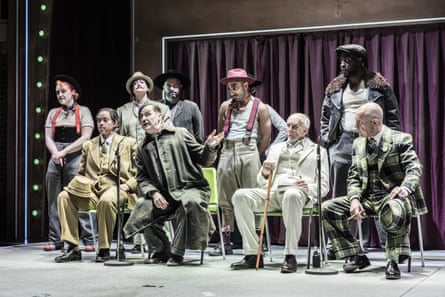
Mawaan Rizwan gives a standout performance, magnetic and maniacal as both an MC in the play’s cod Shakespearean prologue, and as Giri (a satirical version of Hermann Göring). Janie Dee oozes emotion in her various, non-comic roles. The cast, often doubling up, is immaculate alongside them, mastering the balance between Bugsy Malone cartoonishness and menace. It is all laughable, ludicrous and menacing. Brecht’s epic theatre can so easily tip into wooden didacticism, old-fashioned in its overt delivery of moral messages. Linnen leans into the lessons given in scene but they are sobering in their parallels. By the end of the show, there is nothing funny about these vegetable racketeers. They are chilling, cauliflowers and all.
Linnen’s circus-like staging, spectacular in its self-conscious sense of performance, seems in its carnivalesque features as if it has been put through Angela Carter’s creative wringer. It captures Brecht’s point about the theatricality of fascism, from the goose-step walk that Ui develops to his public oratory, both learned from a local actor. The artifice of it all is raised with stylised jazzy swing cymbal patterns (sound design by Johnny Edwards) accompanying some scenes.
The music by Placebo is a highlight, carrying a thumping rock’n’roll energy, manufactured to make gangster violence adrenalised and sexy, rather like a Tarantino film soundtrack. It works, discomfortingly, and a kind of musical violence takes the play to its crescendo. Jennifer Jackson’s choreographed movement works so seductively with the sound while Georgia Lowe’s set is full of colourful chaos. Her costumes are as vibrant: 1930s gangster garb (chequered gabardine and hats) for the cauliflower crew and shambolic outfits for Ui. There is a gradual change in this wardrobe that mirrors their transformation from a rag-tag circus troupe into organised fascists clad in polished Nazi-wear.
When this play was last revived in the UK, in a 2017 production starring Lenny Henry, the parallels to Donald Trump’s ascendancy were hammered home. This revival only goes there once, with Gatiss slipping into his distinctive voice in a courtroom scene (this is not a “self-conscious” effort on press night, according to the RSC). There are sniggers of recognition but it feels redundant. You have already made the connection to the comic grotesquery of our current world. It is the smallest of blips in an otherwise magnificent production.
The drama steps out of its flamboyant artifice in its final moments: “The bitch that bore [Ui] is in heat again,” says Gatiss, in his voice rather than Ui’s. Well, quite.




 English (US)