
 8 hours ago
8
8 hours ago
8

If you like grand designs, you should see the Cosmic House. Beginning in 1978, the postmodernist theorist Charles Jencks and garden designer Maggie Keswick transformed their family home into a vision of the cosmic order at the scale of a Victorian townhouse. A “solar stair” with 52 steps, to give you a flavour, spirals from a “black hole” at its base through four floors with discrete symbolic themes, while the kitchen remixes classical Indian architecture to make a pun about late summer. In a basement dedicated to sun worship is a 25-minute film by Isaac Julien that is likewise wildly excessive, unrepentantly intellectual, thoroughly kitsch and, if you’re prepared to meet it halfway, rather glorious.
Displayed on a single screen at the heart of a kaleidoscope of standing mirrors, the film features Sheila Atim and Gwendoline Christie as science-fiction deities who meander through a Renaissance palazzo, a modernist glass home, and the Cosmic House in the course of a conversation about the end of the world, the possibility of time travel and the nature of God. For reasons that are not immediately clear, they have meaningful encounters with cyborg starfish and conjure up gleaming spaceships. Firestorms leap across the surface of the sun and bioluminescent sea creatures waggle neon tentacles. If you are allergic to pretension, you can stop reading here because this is not the work of art for you.
But if you are willing to meet the film halfway, you may like where it takes you. To get there, it helps to know that its script is cobbled together from snippets of other texts. Most prominent is Octavia E Butler’s Parable of the Sower, which has recently provided rich pickings for the many artists who have noted that it is set between 2024 and 2027 in a dystopian United States. The novel is narrated by Lauren, the daughter of a pastor who takes strength from her own idiosyncratic faith: her logic is everything is changing, and because God is everything, then God must necessarily be change. This is the idea that Julien’s film articulates as a kind of visual poem, expressing the principle that everything flows.
The idea that we are all connected is at once esoteric-sounding and blindingly obvious. To say, for instance, that after death my body will, through the medium of worms, become food for the birds who will sing by my grave is both bad poetry and the plain truth. And it is along this thin line separating platitude from revelation that Julien’s film, with its promiscuous references to everything from Ovid to ecofeminist philosophy, drifts. That I found myself prepared to accept its excursions across both sides of the border might be attributed to the film’s pleasing congruence with its surroundings. When shown last month in an immersive five-screen installation at Victoria Miro gallery, the work came across as aggressively bombastic. In the more domestic surroundings of the Cosmic House, which makes a virtue and a pleasure of magpie intellectualism and immoderate philosophising, I warm to it.
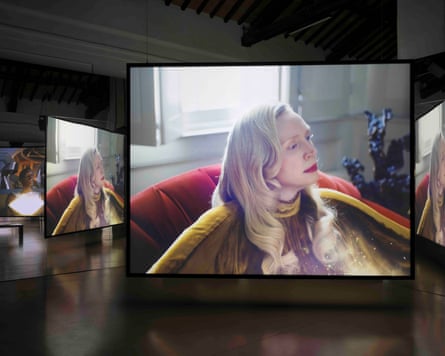
Indeed, it comes to seem quietly revolutionary. In an age fixated on assigning individuals to groups and the politics of representing them, the film’s insistence that no identity is fixed has practical implications. After all, if each of us could be made to realise that we are connected to everything that surrounds us, we might think twice about so thoroughly destroying it. To communicate that point, our goddesses metamorphose into forms ranging from gambolling horses to hovering drones, crossing the boundaries that separate them and us from other people, species and forms of intelligence.
It might seem remarkable that Julien, who came to fame for magnificent films charged with queer Black desire, should create what seems to be a manifesto against identity. But the solidarity this film preaches is based on embracing rather than denying difference, for the kind of diversity that is supported by imaginative empathy. Or, as Lauren says of the gang she forms to survive the apocalypse, “it was from the differences between us, not the affinities and likenesses, that love came”. This love prevents groups from fighting among themselves “until they are conquered by outside forces … or a tyrant”. Like all good works of science fiction, Julien’s film speaks directly to the here and now.
That we urgently need to find some common ground is the message of the philosopher Donna Haraway, who appears at the start of Julien’s film. Like Butler, she proposes we cannot survive the disasters now engulfing us by building bigger walls around smaller and smaller groups. We must learn instead to “stay with the trouble”, embrace the coming change and build new relationships. Here is the simple lesson of this complicated and commendably ambitious work of art: we can’t turn back the clock, things will never be the same and we are all in this together.





 English (US)