
 8 hours ago
8
8 hours ago
8

Manchester has yet to erect a structure that hometown boys Courteeners cannot sell out. But tonight, a stadium band is squeezed into the narrowest of venues. At a heaving Night & Day cafe, disbelieving fans snap photos of their entry wristbands to a rare intimate show in honour of a new greatest hits collection. “Twenty years,” marvels frontman Liam Fray, contemplating his band’s lifespan. “You don’t get rid of us that easily.” For most of the audience there has barely been a Manchester without them.
Charlotte, 18, has seen Courteeners at their enormous Heaton Park shows. “All my friends like them,” she says. Greater Manchester mayor Andy Burnham tells me he became a fan through his son. Paul, 56, has seen them more than 100 times. “There’s not many actual bands any more,” he says, which seems key to their appeal.
Arriving in 2008 as British guitar groups were becoming extinct, Courteeners survived a critical backlash to become one of their generation’s most enduring bands. They fill big rooms nationwide and huge fields at home. It’s left Fray with a complex profile. “I’m not famous,” he says. “But I can’t go to the chippy.” He recently overheard a secondary school band practising in the same rehearsal unit that Courteeners use. They thrashed out a crisp Not Nineteen Forever, his band’s signature hit. Delighted, Fray went and had photos with the stunned kids. “We’ve gone multi-generational,” he says proudly.
Days before the Night & Day show, Fray, 40, greets me at the rehearsal unit where the band also keep an office. He’s strikingly tall and warm, if nervous. “I’m a social creature,” he says, ushering me to a sofa. “But I find people overwhelming and awkward.” Since school he has navigated “off-the-scale” social anxiety. He recently become a father, which he says has made him more positive. Of the band anxiety that once gave him sleepless nights, he says: “I can look at myself and go, ‘This isn’t as important as you think.’”
Fray was once typecast as the heir to the Gallaghers’ throne, but swaggering sits awkwardly with him. In 2020, he began talking publicly about his experiences with depression – today “fairly mild”, but persistent. It began during his first flush of fame. “Not being good enough,” was part of it, but also “the comments section, the pressure, the lack of routine”. Drink helped, “but then you’re in a vicious cycle.” And then there’s the downtime between tours. “You’re supposed to sit at home for six months,” he says, “and then go up and be Freddie Mercury? It fucks you up a bit.”
He managed by adopting a classic frontman persona: slagging off rivals, hyping his band. When he begins to say he was a dick during the band’s early years, he stops and apologises – to himself. “You know what that is?” he says, reflecting on his often severe internal monologue. “That’s, ‘Who the fuck are the Courteeners?’” He reconsiders. “I don’t think there’s an ego there,” he says, hand on chest. “And if there ever was, it was a defence mechanism because I felt out of place.”
Fray was born in 1985 to teacher parents in the north Manchester town of Middleton. “Hard work, compassion and empathy were instilled in us from a young age,” says Fray. His future could have been football (he was a ballboy for Manchester United) but VHS tapes of Oasis and the Beatles turned him into an indie kid. He credits a teenage job at Manchester’s Fred Perry clothes shop with his creative awakening: NMEs in the staff room, flyers for every gig in the city. “I wrote Cavorting” – his second-ever song, Courteeners’ debut single – “on a Fred Perry compliments slip.”
Seeing songwriter Stephen Fretwell live inspired Fray to make a go of music, while “pretentious” parties in Manchester gave him something to rail against. “I seemed like the terrace hooligan,” he says of his mod haircut and ever-present Middleton crew, but the “discomfort” excited him. It inspired the snarling, hyper-local diss tracks Acrylic and Fallowfield Hillbilly, defending “the normal kids” against a perceived hip elite. “It was insecurity,” he says, calling the songs “tongue-in-cheek, satirical.”
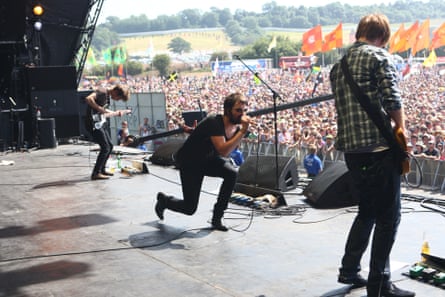
Fray loved the Strokes, the Libertines, the Cribs, and kept expecting a Manchester equivalent, so created his own. He started a band, corralling friends and neighbours – drummer Michael Campbell, guitarist Daniel Conan Moores, bassist Mark Cuppello (who left in 2015) – and they began gigging in 2006. Fray knew “something was happening” at one packed early show. When his microphone broke during Bide Your Time, a demo available on their Myspace, he panicked. “We carried on playing, and the whole place sang the second verse.”
Fray’s songs began attracting industry attention. He thought signing with a major was “selling out”, but went with Polydor anyway. He fluffed his first NME interview by drunkenly taking potshots at the entire indie class of 2007, which he now regrets – mostly. “If you work at Lloyds TSB and you’re in All Bar One,” he says, “a colleague’s going to get slagged off.”
The moment didn’t last. That era’s gold rush on guitar acts was quickly disparaged as “landfill indie”. “We were unfashionable to start with,” says Fray of their predicament, “but now guitar music itself is unfashionable.”
So he moved to New York. Fray had fallen for an American woman. He wrote the band’s second album there, 2010’s Falcon. But its big swing towards Elbow-style anthemics stalled commercially. On the first night of that album’s tour, Fray left a dinner to take a call. Polydor were dropping them. “I went back in and didn’t tell anybody,” he says. “Didn’t tell them for the rest of the tour.” He stayed up that night drinking, then flew to Heathrow for a photoshoot. “I had to get in a Ford Cortina for Q Magazine. I can’t drive, so someone was pushing the car. I thought, ‘This is such a metaphor.’”
What might have been the end became an unexpected second act. “The music industry will kick you around like an empty Pot Noodle,” Fray shrugs, but he knew their audience was loyal: at gigs, “I saw too many people having a good time.” He left America when his relationship ended. Courteeners signed with indie label Pias. Critics remained unimpressed by 2013’s Anna and 2014’s Concrete Love albums, but the band transferred their ambition to the live market.
For years, Courteeners had been reliably selling out Manchester’s arena. In 2015, they sold out the city’s massive Heaton Park. It fitted a pattern of northern indie bands thriving thanks to devout regional support. (They’ve sold the venue out twice since.) Burnham remembers how their shows brought young Mancunians together first after the 2017 Manchester Arena bombing. The Saturday after the attacks, they turned their Old Trafford stadium show into a statement of unity. Fray read a Ryan Williams poem celebrating a “city of tracksuits and bibles and burqas”. For Burnham, any backlash against them is “what generations of northerners have found. People get punished for being completely true to where they are from”.
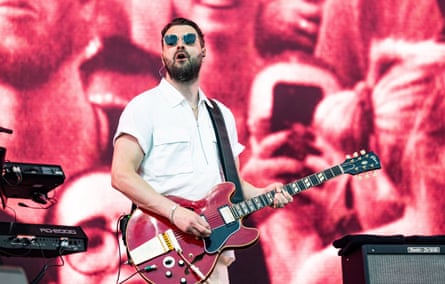
For the new Courteeners greatest hits, Fray wrote two new songs: the romantic Plus One Forever and the plaintively catchy The Luckiest Man Alive. Courteeners once vividly catalogued Manchester hedonism, but the latter’s target, a 4x4-driving pub bore, is suburban. It’s a lifestyle that Fray is “leaning into”. He rhapsodises about National Trust membership, M&S menswear and The Rest is Entertainment podcast. “Ironically,” says Fray, whose songwriting is studded with everyday markers from Debenhams to Parker pens, aren’t those boring details exactly “what people are interested in?”
Fray learned to enjoy the practical aspects of managing his depression: using the alcohol reduction app Reframe; setting his alarm to catch the sunrise; gratitude journalling. “The gratitude list is so nice,” he says. “When you start noticing things, it’s amazing.” It fed into his songwriting, and 2020s songs Take It on the Chin and the jangling Better Man interrogated the awkwardness of therapy and his evolving take on masculinity. “That’s why the lads like us,” he suggests.
He was recently diagnosed with arthritis in both feet from years of perching on his tiptoes to lean into the microphone, and wakes most days in pain. “It’s injections for the rest of my life,” he says. But it’s not going to stop Fray from giving fields full of people joyful memories with their friends: inside the surging, sweaty Night & Day, lads have their arms around other lads, bellowing Fray’s songs at the stage. Bands, he warns darkly, become a “permanent adolescence”. Now he’s making up for lost time. His 40s are for “finding out who I am. Because I was just in the Courteeners.” He flashes a smile. “And that’s a lot for anyone.”





 English (US)