
 19 hours ago
6
19 hours ago
6


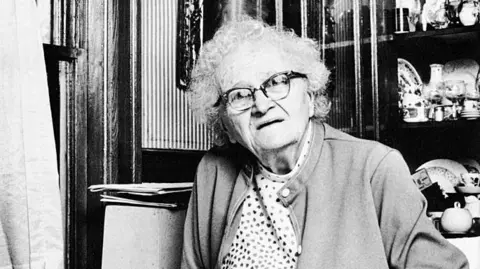 Getty Images
Cecilia Payne-Gaposchkin (1900-1979) was the first woman to earn a PhD in astronomy at Harvard and the first female professor in the university's Faculty of Arts and Sciences
The astronomer who discovered what stars are made of, Cecilia Payne-Gaposchkin, has been commemorated with an English Heritage blue plaque at her teenage home, 70 Lansdowne Road in Notting Hill.
It was while living at this address that Payne-Gaposchkin won a scholarship to Newnham College, Cambridge.
She later earned a doctorate in astronomy from Harvard and in 1927, she became the youngest astronomer ever to have a star of distinction next to her name in the publication American Men of Science.
Senior historian at English Heritage, Howard Spencer, described her as "a scientist of exceptional brilliance and determination".
![SIA Acc. 90-105 [SIA2009-1326]
Air and Space Museum online gallery
Smithsonian Institution/Science Service, restored by Adam Cuerden](https://ichef.bbci.co.uk/news/480/cpsprodpb/6939/live/33a99a40-3da4-11f1-b377-d7765ac78768.jpg.webp) Air and Space Museum
Air and Space Museum
Her groundbreaking 1925 thesis proposed that stars are composed primarily of hydrogen and helium
Her groundbreaking 1925 thesis proposed that stars are composed primarily of hydrogen and helium, a discovery that fundamentally changed scientific understanding of the universe, even though it was initially met with scepticism.
Over the course of her career, she published hundreds of scientific papers and became the first woman to be appointed a full professor at Harvard University.
Her research on stellar atmospheres and variable stars established her as one of the most significant astronomers of the 20th Century.
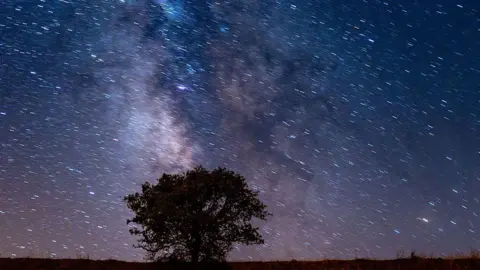 Getty Images
Ratios of hydrogen and helium measured in the Milky Way galaxy match Payne-Gaposchkin's 1925 calculations
Other astronomers commemorated with a blue plaque include Sir Arthur Eddington, who encouraged Payne-Gaposchkin in her early career, and the scientific couple, Walter and Annie Maunder.
Spencer added: "This plaque marks the London home where, as a young woman, she began to develop the knowledge and ambition that would take her to the forefront of modern astronomy.
"Her story is not only one of groundbreaking discovery, but also of perseverance in the face of barriers that limited women in science."






 English (US)