
 15 hours ago
4
15 hours ago
4

Jonathan Zamora was seven years old the last time Mexico hosted the World Cup in 1986. “I witnessed perhaps one of the most sublime moments in the history of football,” he says, retelling a story that has become a pillar of his life.
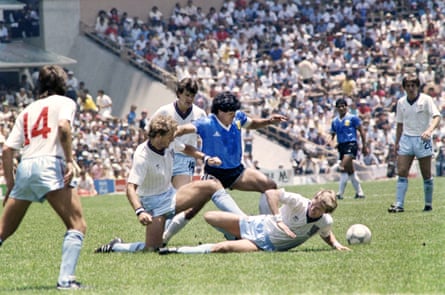
Zamora, a Mexican football fan, does not remember how his father, Antonio, got tickets to the 1986 World Cup quarter-final between Argentina and England at the Azteca Stadium in Mexico City. But he does clearly remember the goals: first when Diego Maradona used his “hand of God” to push the ball past England goalkeeper Peter Shilton. And then the “goal of the century”, where the Argentinian went on a slalom run, dribbling past half the England team before scoring.
In those days, tickets in Mexico were sold in packages of 13 for about $150 per person to see all 13 games [about $442, or £330, today]. “I have very vivid memories and others that are a little blurry. I remember being afraid of the height of the stands; we were in the cheapest seats,” Zamora says. He also recalls “the explosion of emotion” during the game.
When Zamora found out the World Cup would be returning to Mexico, he felt a swell of nostalgia and immediately knew he wanted to buy tickets to go to the stadium again with his father, now 71 years old.
Zamora, who has a master’s degree in petrochemical engineering and works at a company that provides services to the state oil firm, knew the tickets would be expensive but was undeterred. Then reality set in. For the past four months he has been trying – and failing – to purchase seats. Through the Fifa website, he unsuccessfully entered three online ballots for the chance to win an opportunity to buy tickets and has no idea how he will be able to attend the 2026 World Cup in his home country.
“I’d like to think it’s just bad luck on my part, but the reality is that it increasingly feels like there isn’t actually a World Cup in Mexico,” he says.
It is the first time the tournament will be held in three different countries – the United States and Canada are the other co-hosts – with 13 of the 104 matches taking place in Mexico. Seventy-three of the games will be held in the US. “We feel excluded,” Zamora says.
His disappointment is echoed widely among Mexican fans, arguably the most ardent of aficionados in the three host nations. The event, which is supposed to convey an international feeling of solidarity through sport, is taking place in an increasingly tense geopolitical environment as the second term of President Donald Trump has confronted the US’s two close neighbours, levying tariffs and ramping up an anti-immigrant agenda.
The backdrop of unease has been exacerbated by the confusion over who will ultimately be able to attend the games in Mexico. Fifa said it received 5m applications for the ballot that opened on Thursday for 24 hours. According to the governing body, 2m tickets have already been sold across the first two early sales phases, leaving fewer than 5m still available. Zamora says he doesn’t know anyone who has secured a ticket.
“Right now there’s a lot of confusion. In the Sunday football team I play on, at least 20 people have gone through the same process as me, and I don’t know anyone who has got anything,” he says.
Zamora was seeking tickets for the opening match between Mexico and South Africa at the Azteca Stadium on 11 June, which in the final ballot phase cost between $1,290 (£964) and $1,825 (£1,364) for a regular seat, with no guarantee that even putting down that money will secure a ticket. Hospitality options are available, with prices about $10,000 (£7,474). The prices are astronomical in a country where an average professional is paid about 7,500 pesos ($416/£311) per month and far outstrips prices in previous World Cups.
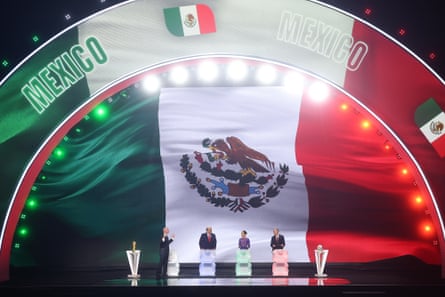
A ticket for a Liga MX match at the same stadium costs about $15 to $50, before the major renovation that started last year. A luxury box seat at the 2024 Clausura final between América and Cruz Azul reached $2,000.
“The prices are not for an average Mexican,” says the Mexican writer Rodrigo Márquez Tizano, author of A Brief History of Almost There, a collection of essays that looks at El Tri’s participation in the World Cups. “The last World Cup in Mexico in 1986 still smelled of sweat and hope,” he says recalling the excitement of spectators waiting to enter the stands. “Today, before even going to the stadium, we’re in a virtual line. Businessmen have appropriated the ball that used to belong to the people.”
Márquez says that after four years of taut anticipation of Mexico once again being on the global stage, the feeling in the country is anticlimactic. “Reality is unfortunately inferior to what we dreamed it would be,” he says, “because there is a feeling that nobody has tickets.” He too has applied to the Fifa ballots without any luck.
Even getting tickets for the matches scheduled in the US has been difficult for Mexican fans. Jorge García, a 40-year-old advertising executive in Mexico City, connected promptly at 10am on Thursday using his Fifa ID to join the virtual queue to participate in the latest tickets ballot. He had his credit card out and was ready to pay for a pair of tickets costing about 5,000 pesos ($265) each, hoping to take his son, León, to the stadium in Houston to see Cristiano Ronaldo in action against Uzbekistan on 26 June.
García waited for two hours to make his application. He also applied for seven games in Mexico City, Monterrey and Guadalajara, and now has to wait until February to know if he was successful or not.
“Everything is very confusing. There’s little communication and clarity here in Mexico regarding the tickets. It seems like this mess is intentional so that you give up and look for tickets on the resale market. This opening match at the Azteca Stadium seems like a rehearsal for what the World Cup will be like,” says a despondent García. He has budgeted up to $700 to pay for a pair of tickets to see Mexico play at home if they become available on the resale market. Fifa said last week it would be releasing a small number of low-price tickets costing $60. They will not be available via the governing body’s official platform but rather through the national associations of the participating teams.
García was only a toddler during the 1986 World Cup but has been avidly following the tournaments on TV since 1994. “I’ve never been to a World Cup and I thought with it being close, I would have a chance. But with these prices, it seems even further away. I guess what’s left is to experience what happens in the streets, the atmosphere, and the friends who come and visit us.”




 English (US)