
 4 hours ago
5
4 hours ago
5

6 minutes ago
Iain Watson,Political correspondentand Henry Zeffman, Jack Fenwick and Joe Pike,Political correspondents

 Reuters
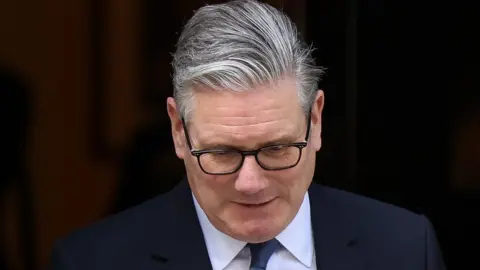
Labour is trailing in the polls and the prime minister's personal ratings have plumbed the depths.
The party is facing losses in forthcoming elections: losing control of Wales, shedding councillors in England, and going into reverse in Scotland.
To put the tin lid on it, the prime minister has been on the back foot over his appointment of Lord Mandelson to the job of ambassador to the US, and the subsequent sacking of senior civil servant, Sir Olly Robbins, in a row over security vetting.
So the question being asked around Westminster is not 'should there be a Labour leadership contest?' – but 'why is such a contest not expected on 8 May', the day after the expected electoral drubbing?
One Labour MP, Jonathan Brash, has called for Sir Keir to resign, and to set a timetable for his departure. Some others have agreed with this privately.
Nonetheless it is significant that no-one is publicly echoing Brash's call and the prevailing mood seems to be against an imminent leadership challenge.
One long-standing Labour MP has his take: "Keir Starmer is basically dead, isn't he? And because people think it is inevitable that he won't lead us into the next election, there isn't the rush."
While there are some noises about having a so-called caretaker leader, many MPs would be reluctant to do this.
As one of them put it: "We have to be sure that when there is a contest we can have a candidate who can lead us in to the next election."
They added that it would be disastrous for trust if the party 'chopped and changed', and trying to find that candidate who can re-inspire the party, never mind the voters, is proving elusive.
The one thing left and right seem to agree on is that there is no obvious leader-in-waiting who is currently in Parliament.
One MP from the centre-left of the party said: "The PLP (Parliamentary Labour Party) thinks the situation is terminal – but we have thought that since February. We don't have an option in Wes [Streeting] because of the Mandelson thing - despite his data dump of the text messages with him.
"And there is a growing 'stop Ange' [Angela Rayner] mood because we don't think she'd win an election."
An MP further to the left said that Rayner, the former deputy leader, was "compromised" by her tax affairs and by "taking up lucrative speaking engagements".
Meanwhile, a minister drew a lesson from Labour's Scottish leader Anas Sarwar's call for Sir Keir's resignation in February: it could have fired the starting gun on a leadership contest, but culminated in declarations of loyalty from ministers.
"What it proved was neither Wes nor Angie were ready for it. I was waiting for a call (from Steeting's team) and it never came," they said.
And a Labour figure whose career can be traced back to the Blair era said that after days of damaging headlines about Lord Mandelson, people were angry.
"We will tank in the elections. But we are back where we were a week ago. There is no easy mechanism (to remove a leader) and there is no obvious candidate."
However, one potential candidate is still being spoken about by MPs. As one former frontbencher put it: "The problem is that the solution isn't in Westminster."
They were, of course, talking about Andy Burnham, who was blocked from standing as a candidate for Westminster in the Gorton and Denton by-election earlier this year.
"He is the person who just about everyone could live with - unless you are Wes Streeting."
Another potential Burnham supporter was more downbeat. He recognised that the Greater Manchester mayor would need to stand in a "very safe seat" given Labour's polling, and that a supportive MP would have to stand down.
Burnham would also need the approval of Labour's ruling body, the National Executive – the composition of which could move in his favour this summer.
But one MP's analysis would have convinced Sir Keir that he was right – from the point of view of political survival – to have vetoed the mayor's candidacy.
"If Andy had been back (in Westminster) things would have moved by now," they said.
Some MPs are more fatalistic. A minister told us: "Starmer is seriously unpopular. I think we are going to lose the next election. The only way we win is if people feel better off and I have not heard a serious argument from any possible candidate about how they could achieve that in such a short space of time."
Some are looking to those closest to Sir Keir to conduct the defenestration, just as Conservative PM Margaret Thatcher was told to leave, more than three decades ago
One MP told us: "Lots of cabinet ministers seem to know that he is not going to lead us in to the next election - the question is whether they want to force something to happen soon or to wait until it's too late."
But some MPs believe that ministers are taking an 'everyone for themselves' approach. One minister's assessment was that "they are on manoeuvres".
And several ministers have privately questioned the manner of Sir Olly Robbins's dismissal.
One influential Labour figure interpreted this as a sign of fraying loyalties, and said "serious cabinet ministers are not prepared to defend [the PM] or sully themselves".
Another MP said: "They are looking for life rafts. They are thinking six months ahead, and they are saying that they would still very much like to be in the cabinet. Someone else's cabinet."
An MP close to Miliband proffered a more straightforward explanation. "Ed just said: Stuff this, I'm telling the truth."
There had been talk of the PM regaining the initiative after the May elections not just with a programme of new legislation in the King's Speech, but by having a reshuffle.
That feels riskier now than it did before the latest Mandelson revelations. Disgruntled ex-ministers can prove dangerous.
Under the radar, the prime minister has been working hard to shore up his position with sceptical MPs.
There have been receptions for backbenchers, including trips to Chequers, his grace-and-favour country pile.
He is undertaking a round of meetings with regional groups of MPs and internal campaign groups. On Wednesday, he met the Red Wall group, whose members are largely in Reform-facing seats, to discuss how the party's industrial strategy can extend to small and medium sized towns.
Attendees report that such meetings are "constructive", MPs can be frank - and that Sir Keir listens more than he speaks.
And after the departure of Morgan McSweeney as chief of staff, some MPs who had felt cold-shouldered now report that they are having proper engagement with No 10.
Sir Keir's political director Amy Richards – formerly a long standing aide to Yvette Cooper – is being praised for dismantling what was seen by some as a boy's club behind the black door of No 10.
That said, we are told that members of the women's PLP are incandescent about the Doyle revelations, and they want to see more women promoted to prominent positions.
So even after the past week, a leadership melodrama seems far from certain.
Brutally bad results are – in a phrase used by several MPs – "priced in".
But often there is a difference between theory and practice. How will that loss of seats feel after elections next month? What will angry ex-councillors be saying to their MPs?
Some believe the emotional impact of electoral defeats could be too much to bear.
"People think they are ready for it but there is a real chance of things going crazy that weekend. Everything could collapse very fast," one MP says.
Another put it like this: "The PLP is like a tinderbox – it might just ignite in May."
But one MP recounted the fears of a colleague loyal to the PM: "They said to me, 'I do hope the PLP doesn't do anything rash'.
"I said 'there's no chance of the PLP ever doing anything rash'."



 English (US)