
 17 hours ago
5
17 hours ago
5

Christmas for me began as a summertime celebration in New Zealand, with long days and warm evenings. Twenty-plus years on, the wintry cosiness of a UK Christmas has taken hold. Now, my essentials include perfectly crisp roast potatoes with plenty of gravy, and sprouts (non-negotiable). Even my young niece and nephew love them, which is a small victory I’m quietly proud of.
Blue cheese and honey gougères

Warm gougerès fresh from the oven are a pretty tricky thing to beat. However, adding blue cheese and honey steps them up another level. The best thing about these gougeres, though, is you can make and freeze them in advance, meaning they’re never more than 25 minutes away.
Prep 10 min
Cook 40 min, plus freezing
Makes 24
65g unsalted butter, diced
3g fine salt
1 tbsp honey
85g strong flour
60g blue cheese, crumbled
2 eggs, beaten
1 egg yolk, beaten
1 tsp honey, to finish
Put the 165g water, the butter, salt and honey in a medium saucepan and bring to a boil on a high heat, making sure the butter has fully melted. Tip in the flour all at once, then stir hard until the mixture forms a smooth dough that pulls away from the sides of the pan. Take off the heat and stir in 40g of the crumbled blue cheese until evenly combined.
Transfer the dough to a bowl and leave it for a minute or two to cool slightly. Add half the beaten eggs, mix until well incorporated, then add the rest of the eggs and beat until the dough is smooth and glossy. Spoon the dough into a piping bag fitted with a large, plain nozzle, then pipe out 2cm mounds on to a baking sheet lined with a silicone mat or greaseproof paper (alternatively, pipe it directly into small financier moulds for neat, even shapes). Freeze until solid (about two hours), then transfer the gougeres to an airtight container and keep in the freezer until needed.
To bake, arrange the frozen gougeres 2cm apart on a lined baking tray, then brush the tops lightly with the beaten egg yolk. Heat the oven to 220C (200C fan)/425F/gas 7, then bake the gougeres for eight minutes. Turn down the temperature to 190C (170C fan)/375F/gas 5 and bake for 10 minutes more, until puffed and golden.
Take out of the oven, brush the tops with the honey and scatter over the remaining 20g blue cheese. Return to the oven for five minutes, until the cheese melts and the tops turn shiny.
Roast squash velouté, pickled walnut, Baron Bigod

A rich squash soup is like a hug in a bowl, and this version suitably dazzles with two of my favourite winter ingredients: pickled walnuts and Baron Bigod. It’s a dish that also uses the whole squash (seeds and skin included), so there’s minimal waste and maximum taste.
Prep 10 min
Cook 1 hr 30 min
Serves 4
1 onion squash, or red kuri squash
2 sprigs fresh rosemary
1 bay leaf
50g unsalted butter, diced
Salt
1 tbsp vegetable oil
100g pickled walnuts, chopped
100g Baron Bigod
Scrub the squash well, then peel it; keep the peelings. Cut the squash in half and scoop out the seeds. Put the seeds in a medium saucepan with the rosemary and bay leaf, cover with two litres of water and bring to a boil. Cook for 30 minutes, then strain into a clean pan and discard the solids.
Heat the oven to 220C (200 fan)/425F/gas 7. Cut the squash flesh into large chunks, spread them out on a baking tray, add the butter and a generous pinch of salt, and roast for 20 minutes. Transfer the roast squash to the pot of strained stock, add a little more salt and simmer for five minutes. Blend until completely smooth, then taste and adjust the seasoning.
Turn down the oven to 190C (170 fan)/375F/gas 5. Toss the squash peelings with the tablespoon of oil and a little salt, spread out on a baking tray and bake for 12–20 minutes, moving them around from time to time so they cook evenly, until crisp.
To serve, divide the chopped pickled walnuts between four warmed bowls. Using a hot knife, slice the cheese into 12 neat pieces and place three in each bowl. Top with the crisp squash skin. Serve the hot velouté in a jug or jugs at the table, so guests can pour it around the garnish.
Mushroom and celeriac pithivier
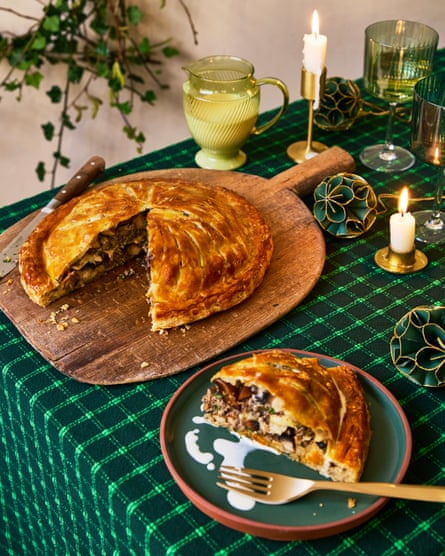
A showstopper is required for Christmas day, and what better way to do that than with a delicious pie (of sorts)? While there’s a bit of preparation involved, trust me, this is well worth the effort.
Prep 15 min
Cook 2 hr 30 min
Chill 1 hr
Serves 4 with enough for leftovers
500g block puff pastry
Flour, for dusting
1 large celeriac
20g miso (red or white)
20g bunch thyme
10 tbsp vegetable oil
Salt and black pepper
1kg chestnut mushrooms, quartered
4 garlic cloves, peeled and bashed
50g unsalted butter
250ml vegetable stock, or mushroom stock
150ml double cream
2 tbsp cream sherry
20g bunch parsley, leaves picked and finely chopped
1 egg, separated
Begin by rolling the pastry so it has time to rest. Divide the pastry block into two pieces, one weighing about 200g and the other about 300g. Shape each piece into a disc, then roll out into two circles, the smaller piece to about 25cm in diameter and the larger one to about 40cm. Dust both lightly with flour, cover with a tea towel and refrigerate for 25 minutes.
Heat the oven to 200C (180 fan)/390F/gas 6. Scrub the celeriac well, then peel it, reserving the peelings. Put the peelings on a baking tray and roast for 15 minutes, until golden. Tip the peelings into a medium saucepan, cover with a litre of water, add the miso and half the thyme, and bring to a boil. Simmer for 20 minutes.
Slice the peeled celeriac into 5mm rounds. Brush both sides with oil, season well and roast on a tray for 10 minutes. Turn over the slices and roast for another 10 minutes.
To cook the mushrooms, heat two tablespoons of vegetable oil in a large saucepan. Once hot, add a quarter of the mushrooms, along with the remaining thyme and all the garlic, season with salt and cook until golden. Add a quarter of the butter and continue cooking until all the liquid in the pan has evaporated. Leaving the thyme and garlic in the pan, transfer the mushrooms to a tray. Repeat this process three more times with the remaining mushrooms, reusing the thyme and garlic each time. After the third batch, chill the cooked mushrooms. With the final batch, once the mushrooms are golden, pour in the stock and simmer for 10 minutes. Lift out and discard the thyme, add 50ml cream and blend to a chunky puree. Cover and chill.
Strain the celeriac peel stock and discard the solids. Pour the liquid into a clean pan, bring to a simmer and add the sherry. Reduce gently for five minutes, then add the remaining cream. Boil rapidly for 10 minutes, to thicken slightly, then taste and adjust the seasoning.
To assemble the pithivier, lay the smaller pastry circle on a piece of baking paper. Using a small knife, lightly score a 15mm border all around the edge. Arrange half the roast celeriac slices inside the border, then top with half the mushroom puree. Stir the chopped parsley into the chilled mushrooms, then spoon half the mushrooms on top. Repeat the layers with the remaining celeriac, mushroom puree and chilled mushrooms.
Lightly beat the egg white and brush it all around the scored border. Drape the larger pastry circle over the top of the filling, then, using the sides of your hands, press firmly around the edges to seal, keeping the dome as tall as possible. Chill for 15 minutes, then trim neatly into a perfect circle (use a tart ring or cake tin as a guide). The pithivier can now rest overnight in the fridge or be baked straight away.
When you’re ready to bake, heat the oven to 220C (200C fan)/425F/gas 7. Brush the top and sides with the beaten egg yolk, chill for 10 minutes, then repeat the glazing and chill again. Mark a tiny dot in the centre of the pastry with the tip of a knife. Starting from the base of the dome, lightly score curved lines sweeping up towards the centre dot, working all the way around to create a sunburst pattern. Bake for 10 minutes, then turn down the heat to 200C (180C fan)/390F/gas 6, and bake for 10 minutes more, until deep golden. Serve with the warm celeriac sauce.
Roast miso brussels sprouts
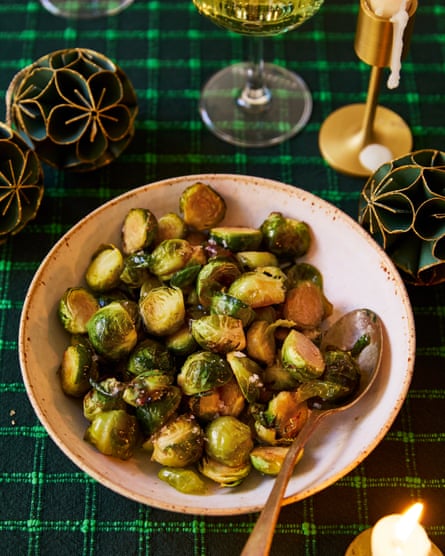
I’m firmly team sprout – and team miso – so this combines the best of both worlds. Just ensure you get enough heat on the wee morsels to induce that nutty flavour.
Prep 5 min
Cook 25 min
Serves 4 as a side
50g vegetable oil
Salt
300g brussels sprouts
20g miso paste (red or white)
Pour the oil into a deep roasting dish, add a good pinch of salt, put the dish in the oven and turn it on to 220C (200C fan)/425F/gas 7.
Halve the sprouts or, if they’re larger than a 50p piece, quarter them. Once the oven is up to temperature, carefully tip the sprouts into the hot oil – they will spit, so be cautious – then roast for 12 minutes.
Meanwhile, mix the miso with four tablespoons of water until smooth. Take the tray out of the oven and carefully stir the miso mixture through the sprouts. Turn down the oven to 200C (180C fan)/390F/gas 6, then roast the sprouts for six minutes more. Serve hot.
Caramelised pear and rosemary pudding
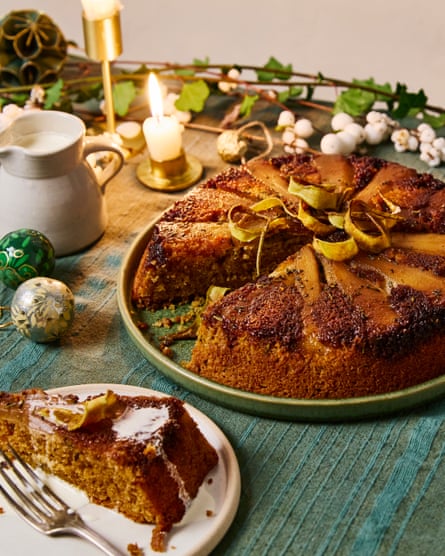
There’s an alchemy with pears, caramel and rosemary, and this pudding just affirms it. The floral notes in the pear and rosemary match so perfectly, resulting in a wonderful way to wrap up your festive feast.
Prep 10 min
Cook 1 hr 15 min
Serves 4–6
3 pears – comice or conference
275g unsalted butter, softened
150g soft dark brown sugar
2 sprigs fresh rosemary, leaves picked and finely chopped
105g caster sugar
3 eggs, lightly beaten
A pinch of salt
200g self-raising flour, sieved
2 tsp vegetable oil
Custard, cream and/or ice-cream, to serve
Heat the oven to 200C (180C fan)/390F/gas 6. Peel, quarter and core the pears, keeping the peelings. Press 75g of the butter in an even layer over the base of a 22cm-25cm ovenproof cast-iron pan or deep pudding dish. Sprinkle over 75g of the soft brown sugar, then lay the 12 pear quarters cut side down in a spiral on top (you may need to trim the tops to make them sit neatly). Scatter over the chopped rosemary, then bake for 10 minutes.
Meanwhile, cream the remaining butter with the remaining soft brown sugar and 100g of the caster sugar until thick and fluffy. Beat in the eggs, then add the salt and gently fold in the sieved self-raising flour.
Spread out the pear peelings on a baking tray. Add one and a half teaspoons of the oil and the remaining 5g caster sugar, and toss with your hands to coat.
Remove the pudding dish from the oven and turn down the heat to 180C (160C fan)/350F/gas 4. Bake the sugared peelings for 20-30 minutes, moving them around occasionally, until crisp.
Brush the sides of the pudding dish with a little of the remaining vegetable oil. Spoon the cake batter on top of the caramelised pears and smooth the surface. Bake for about 20 minutes, or until a skewer inserted into the centre comes out clean.
To serve, while the pudding is still warm, gently shake the dish to loosen it from the sides. Invert a large plate on top, then flip the whole thing over and lift off the pudding dish so the pears are now on top. Spoon any caramel left in the dish all over the pudding, scatter with the crisp pear skins, then serve with lashings of custard, cream and/or ice-cream.
-
Chantelle Nicholson is chef/patron of Apricity, London W1









 English (US)